
The Rongai route climbs Kilimanjaro from the north-eastern side of the mountain, along the border between Tanzania and Kenya. It still feels like unspoilt wilderness, and approaching from the north gives you a different view of the mountain.
One thing to know, though: the shape of this route doesn't let you follow the “climb high, sleep low” principle, so hikers generally suffer more from altitude sickness on Rongai than on other routes. That's why we strongly recommend adding an extra acclimatisation day. The Rongai route uses the scree path from Kibo hut to Gillman's Point to reach the summit, and comes down via the Marangu route.
6 days on Rongai
-
Day 1: Rongai start point to Simba camp
- Hiking time
- 4 hours
- Distance
- 6.7 km
- Habitat
- Forest (Montane)
You'll leave Moshi and drive 45 minutes to the Marangu park gate to register. From there, it's another 68km, roughly 2 ½ hours on bumpy roads, to Naro Moru in north-east Kilimanjaro and the Rongai start point (1996m). You'll meet your guide and porters before setting off on foot from Nale Moru village. The little winding path crosses maize fields, enters pine forest, then climbs gently through the forest. It's not steep at all, just a gentle hike through beautiful countryside. Your first night's camp is Simba Camp (2 626m), which has a public toilet and a wooden table with benches, but no hut.
-
Day 2: Simba camp to Kikelewa camp
- Hiking time
- 6 – 7 hours
- Distance
- 11.8 km
- Habitat
- Moorlands
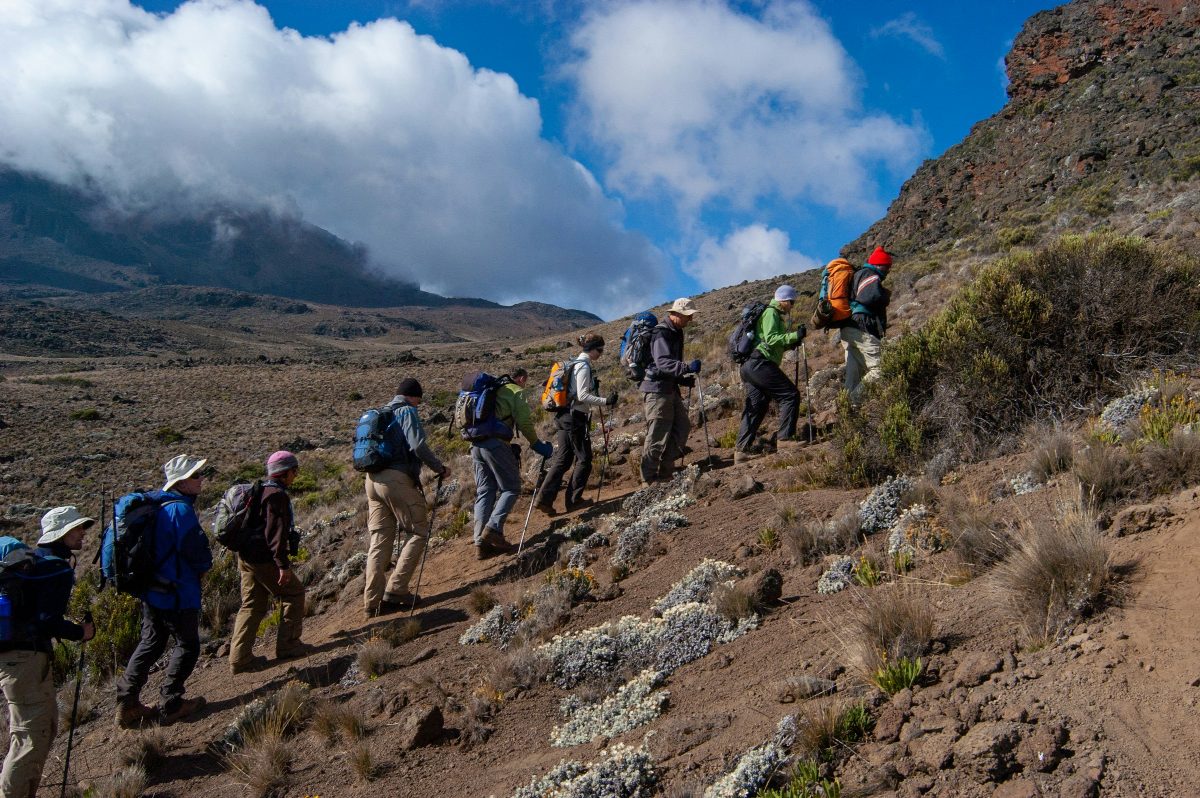
We'll hike from Simba camp up towards Kibo, reaching 3 482m for lunch at First Caves, a distance of 5.8km. After lunch, we keep trekking until we reach Kikelewa Camp, at about 3679 metres. The views really start to open up here, and you'll begin to feel like you're on a seriously big mountain! You can find water in an obvious stream below the cave, although you might need to wander a little way downhill to find a pool or two. Dinner and overnight at Kikelewa camp.
-
Day 3: Kikelewa cave to Mawenzi tarn camp
- Hiking time
- 3 hours
- Distance
- 3.7 km
- Habitat
- Moorlands
A short but steep climb up grassy slopes, with superb views over this wild area. The vegetation runs out just before you reach your next camp at Mawenzi Tarn, which sits spectacularly beneath the towering spires of Mawenzi. You'll spend the afternoon acclimatising and exploring.
-
Day 4: Mawenzi tarn camp to Kibo hut
- Hiking time
- 5 hours
- Distance
- 9 km
- Habitat
- Alpine desert
After breakfast, we head west, climbing along the east side of Kibo and crossing the saddle between Mawenzi and Kibo. It takes 4 to 5 hours to reach Kibo Hut. You'll spend the rest of the day resting up for the final climb, which starts around midnight. Overnight at Kibo hut.
-
Day 5: Kibo hut to Uhuru peak to Horombo hut
- Hiking time
- 7 to 8 hours to reach Uhuru Peak, 6 to 8 hours to descend to Horombo
- Habitat
- Stone scree / ice-cap summit
You'll get up at around 23h20, and after some tea and biscuits, you'll set off into the night. This is where it gets really tough. The first section is a rocky path to the Hans Meyer Cave (5150m), which is also a good place to rest. Then the path zigzags up to Gillman's Point (5 681m) on the crater rim. This part is very steep, with lots of loose scree, and it takes a huge physical and mental effort. It's probably the hardest section of the whole route, so do the “Kili shuffle” and move slowly. From Gillman's Point, you'll usually find snow all the way up to Uhuru Peak (5895m), the highest point in Africa. You've made it, and what a feeling! How long you can stay at the top taking photos depends on the weather, before the 3-hour descent back to Kibo hut. After a short rest there, you'll collect the gear you left behind for the climb and head down to Horombo hut (3 hours) for the night. The walk back to Horombo will feel surprisingly quick compared with the way up. In total, you'll spend around 14 hours walking today, so be ready for a very tough day. In the evening, you'll enjoy your last dinner on the mountain (soft drinks and beer are on sale at the camp office) and a well-earned sleep, full of memories and big emotions.
-
Day 6: Horombo hut to Marangu gate
- Hiking time
- 6 hours
- Distance
- 19.7 km
- Habitat
- Moorland & Montane Forest
After breakfast, you'll carry on down (6 hours), past Mandara hut, to the Marangu gate. A tip from us: don't pay your porters any tips until you and all your gear have reached the gate safely. Our tipping guide has more on this. At Marangu gate, you'll sign your name and details in a register, and this is also where successful climbers get their summit certificates. If you reached Gillman's Point (5685m), you'll get a green certificate, and if you made it to Uhuru Peak (5895m), you'll get a gold one. Then it's the drive back to Moshi for a long-overdue hot shower, dinner, a proper bed and celebrations!
The day-by-day details (hiking times, distances, habitats and elevations) come straight from our original Kilimanjaro page. We've rewritten the descriptions to read more easily, without changing the facts. Elevations appear where that page gave them, in the units it used.
Fancy a different way up?

Lemosho Route
Why do we prefer the seven-day Lemosho to the six-day version? Because it splits day two into two days, which gives you better acclimatisation and a more gradual climb. On…
Machame Route
Only have six days to climb Kilimanjaro? Then Machame is your best choice, thanks to the way it helps you acclimatise. Compared with other six-day routes, Machame takes you higher…

Marangu Route
Marangu is one of the most popular routes to the top of Kilimanjaro. Why? Partly because it's the least expensive route, but probably more because you can do it in…