
Marangu is one of the most popular routes to the top of Kilimanjaro. Why? Partly because it's the least expensive route, but probably more because you can do it in 5 days, reaching the summit a day sooner than on the Machame route. That isn't always the best idea, though, because it gives you less time to acclimatise.
The good news is that Marangu gives you the option of an extra acclimatisation day on the mountain. That turns it into a 6-day trek, and it really boosts your chances of success. The biggest difference from the other routes is where you sleep: in shared huts, all the way along, which is a relative luxury on Kilimanjaro. Mineral water, soft drinks, chocolate and beer are on sale at every camp on this route, too. Porters carry all your equipment and supplies, and a cook prepares all your meals.
So what's the difference between the 5-day and 6-day Marangu routes? It's that extra acclimatisation day at Horombo Hut.
6 days on Marangu
-
Day 1: Marangu gate to Mandara hut
- Hiking time
- 5h
- Distance
- 8.1 km
- Habitat
- Montane forest
It takes about 50 minutes to drive from Moshi to the Kilimanjaro National Park gate, passing through Marangu village on the lower slopes of the mountain. At the gate, everyone signs in at the park office and makes their final preparations for the climb. You'll see the porters sorting and loading their packs with the food, water, cooking gas and most of your equipment. Make sure you've got your daypack with you (with at least drinking water, your packed lunch and extra clothing), because the porters climb a lot faster than hikers do! Our guides will be on hand to help with any questions or anything else you need.
From the park gate, you'll climb a cleared ridge trail through the rainforest. This forest, full of mist and dripping with beards of moss, is also where most of Kilimanjaro's animals live. A few minutes after the gate, a more scenic forest trail branches off to the left, running parallel to the main one. It follows a stream through the undergrowth, and you can rejoin the main trail either after 1.5 hours of hiking, or 1 hour before Mandara hut.
Your first night is at Mandara hut, a group of wooden A-frame huts in a forest clearing. Each hut has 6-8 bunks with solar-powered lighting, and the camp holds 60 climbers in total. Water is piped in from springs above, and there are flush toilets behind the main hut. Our cook will prepare dinner, served in a shared dining hall.
-
Day 2: Mandara hut to Horombo hut
- Hiking time
- 6h
- Distance
- 11.6 km
- Habitat
- Moorland
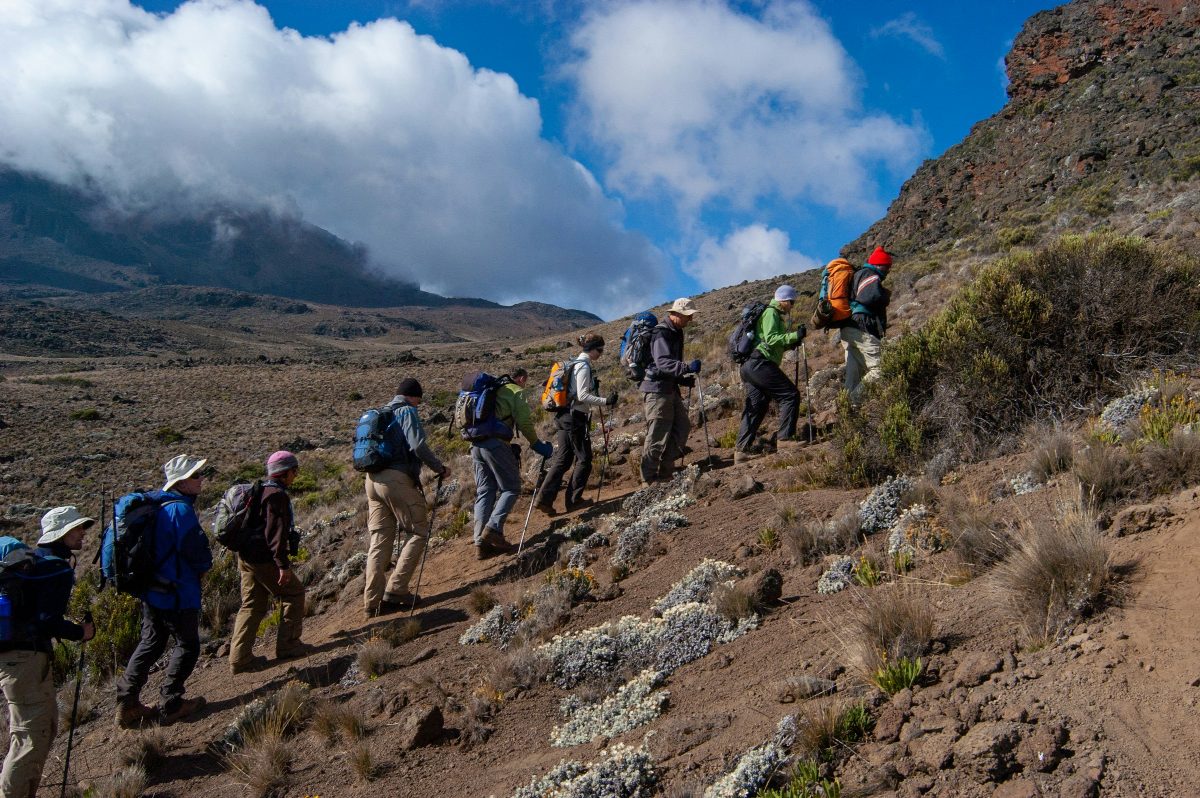
From Mandara hut, the trail passes through a short stretch of forest, skirts the base of the Maundi Crater and then comes out where the rainforest gives way to moorland. It's well worth a short detour to scramble up the rim of the Maundi Crater for your first really impressive view of the Kibo Crater. On a clear day, Kibo glimmers in the distance, showing off her glaciers in the morning sun. Out on the open moorland, you'll get to see some of Kilimanjaro's most spectacular plants: the endemic giant lobelia, which grows up to 3 m tall, and the giant groundsel (Senecia Kilimanjari), which can reach 5m! After about 6 hours of trekking, you'll reach Horombo hut, where a hot bowl of washing water, a rest, dinner and a night's sleep are waiting for you.
-
Day 3: Horombo hut to acclimatisation day
- Hiking time
- 4 ½ h
- Habitat
- Alpine desert
Horombo hut is a little village of huts perched on a small plateau. The buildings are similar to Mandara's, but it holds up to 120 climbers! It's usually buzzing with hikers, guides and porters, and there's a real sense of adventure in the air. You'll meet people on their way up and on their way down. This extra day and night at Horombo is all about acclimatisation. We strongly recommend a hike towards Mawenzi hut (4 310m), passing the Zebra Rocks on the way (about 3 hours up and 1.5 hours down), because it'll help you acclimatise even more. Remember to drink plenty of water, and take it slowly. All your meals for the day are provided at the hut. Get to bed early and enjoy one last good night's rest.
-
Day 4: Horombo hut to Kibo hut
- Hiking time
- 6h
- Distance
- 9.6 km
- Habitat
- Alpine desert
After breakfast, you'll climb on into the alpine desert. From Horombo, two trails lead up to the “Saddle”, the area between the peaks of Mawenzi and Kibo. You can choose the upper route (the right-hand fork) or the lower route (the left-hand fork). The upper route should feel very familiar, because you'll have climbed most of it the day before on your acclimatisation hike towards Mawenzi hut. It's very stony and eroded. We recommend the lower route: it's much easier, nearly an hour shorter, and it passes the last water point at 4130m. Fill your water bottles there with everything you'll need until you're back at Horombo hut two nights later (unless you're happy to buy mineral water at Kibo hut). And again, slow down and drink plenty!
Kibo hut sits in the barren alpine desert. It's a stone blockhouse with bunk beds for 60 climbers, but there are no streams nearby. You can buy mineral water and soft drinks at the camp office, though, and there are platform toilets behind the hut. The summit is another 1195m up, and you'll make your final climb that same night. Get your equipment, ski stick and thermal clothing ready for your summit attempt. That includes putting fresh batteries in your headlamp and camera, with a spare set too. To stop your water freezing, it's a good idea to carry it in a thermal flask. Head to bed at around 19h00 and try to get as much rest and sleep as you can.
-
Day 5: Kibo hut to Uhuru peak to Horombo hut
- Hiking time
- 7 to 8 hours to reach Uhuru Peak, 6 to 8 hours to descend to Horombo
- Habitat
- Stone scree and ice-capped summit
You'll get up at around 23h20, and after some tea and biscuits, you'll set off into the night. This is where it gets really tough. The first section is a rocky path to the Hans Meyer Cave (5150m), which is also a good place to rest. Then the path zigzags up to Gillman's Point (5 681m) on the crater rim. This part is very steep, with lots of loose scree, and it takes a huge physical and mental effort. It's probably the hardest section of the whole route, so do the “Kili shuffle” and move slowly. From Gillman's Point, you'll usually find snow all the way up to Uhuru Peak (5895m), the highest point in Africa. You've made it, and what a feeling! How long you can stay at the top taking photos depends on the weather, before the 3-hour descent back to Kibo hut. After a short rest there, you'll collect the gear you left behind for the climb and head down to Horombo hut (3 hours) for the night. The walk back to Horombo will feel surprisingly quick compared with the way up. In total, you'll spend around 14 hours walking today, so be ready for a very tough day. In the evening, you'll enjoy your last dinner on the mountain (soft drinks and beer are on sale at the camp office) and a well-earned sleep, full of memories and big emotions.
-
Day 6: Horombo hut to Marangu gate
- Hiking time
- 6h
- Distance
- 19.7 km
After breakfast, you'll carry on down (6 hours), past Mandara hut, to the Marangu gate. A tip from us: don't pay your porters any tips until you and all your gear have reached the gate safely. Our tipping guide has more on this. At Marangu gate, you'll sign your name and details in a register, and this is also where successful climbers get their summit certificates. If you reached Gillman's Point (5685m), you'll get a green certificate, and if you made it to Uhuru Peak (5895m), you'll get a gold one. Then it's the drive back to Moshi for a long-overdue hot shower, dinner and celebrations!
The day-by-day details (hiking times, distances, habitats and elevations) come straight from our original Kilimanjaro page. We've rewritten the descriptions to read more easily, without changing the facts. Elevations appear where that page gave them, in the units it used.
Fancy a different way up?

Lemosho Route
Why do we prefer the seven-day Lemosho to the six-day version? Because it splits day two into two days, which gives you better acclimatisation and a more gradual climb. On…
Machame Route
Only have six days to climb Kilimanjaro? Then Machame is your best choice, thanks to the way it helps you acclimatise. Compared with other six-day routes, Machame takes you higher…

Rongai Route
The Rongai route climbs Kilimanjaro from the north-eastern side of the mountain, along the border between Tanzania and Kenya. It still feels like unspoilt wilderness, and approaching from the north…